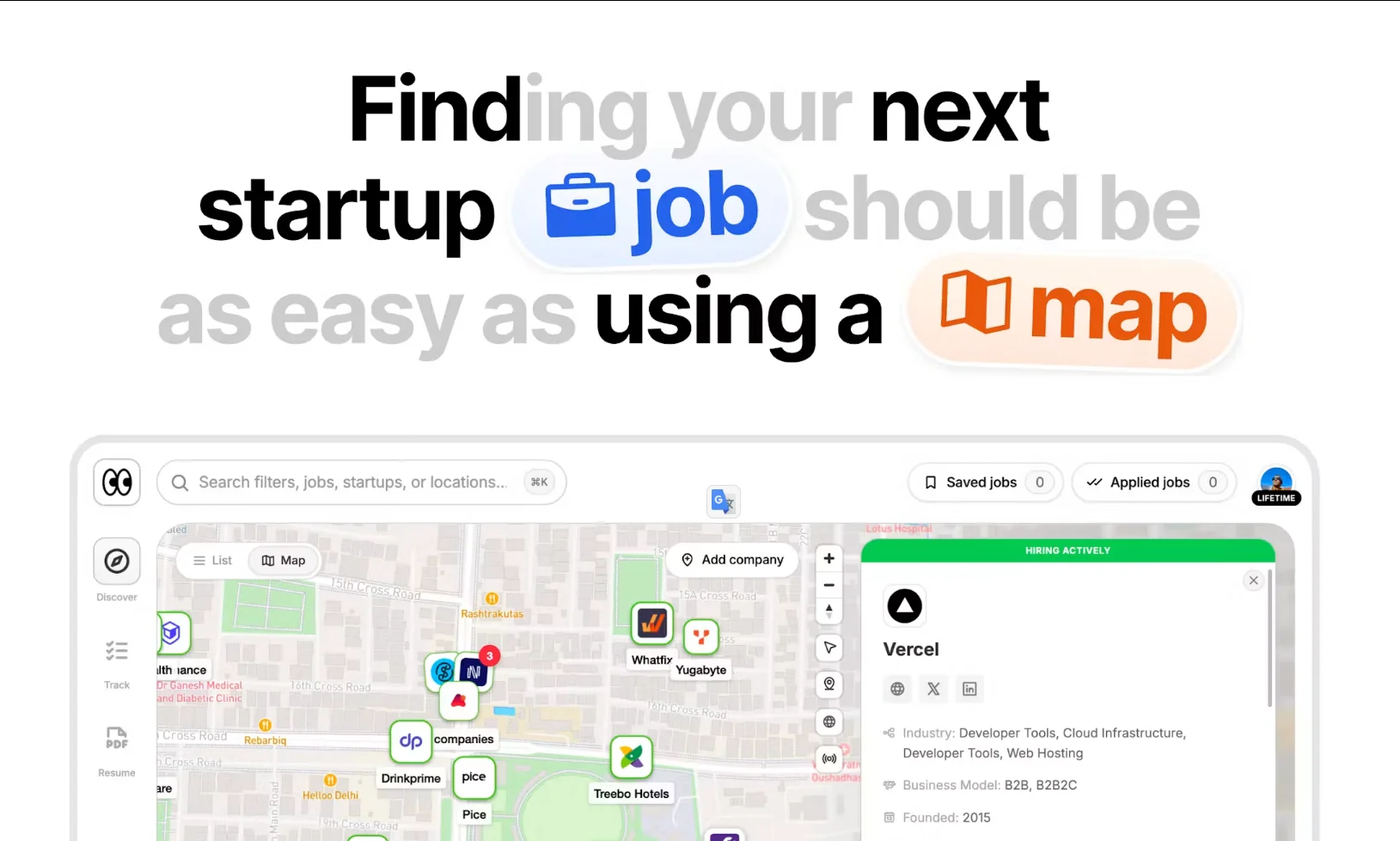
On Product Hunt, NextDoor.Company launched as a fresh take on job discovery: “Find startups hiring nearby you on a beautiful map.” The official site at nextdoor.company opens with a simple thesis — finding your next startup job should be as easy as using a map. Instead of endless scrollable job boards or noisy LinkedIn feeds, the product places actively hiring startups on an interactive map so candidates can explore opportunities geographically, filter by signal, and dig into rich company context without jumping across ten tabs.
Built by designer-turned-solopreneur Sankalp Sinha (who left a high-paying product role to bootstrap the project), NextDoor.Company is a visual job-intelligence platform focused on funded and notable startups. Early public figures referenced hundreds of companies and tens of thousands of open roles, with data refreshed regularly. Users can zoom into neighborhoods or cities, click company pins, view open roles, funding stage, investors, benefits, work mode, and more — all in one place.
This review examines NextDoor.Company from every practical angle: the problem it solves, the map-first experience, company and job data depth, filters and discovery, user feedback themes, strengths, limitations, and who will get the most value.
The Problem It Solves
Traditional job search for startup roles is fragmented and exhausting. Candidates bounce between LinkedIn, company career pages, AngelList/Wellfound, Notion boards, Twitter threads, and private communities. Information is incomplete or outdated: funding details live on one site, benefits on another, actual open roles on a third, and office location is often buried. For people who care about working at interesting startups — especially those who prefer (or need) proximity, hybrid options, or specific ecosystems — the lack of spatial context makes discovery inefficient.
NextDoor.Company reframes the problem as exploration rather than grinding through lists. By putting companies on a map, it surfaces startups “you didn’t know existed” near you and turns job hunting into something closer to browsing a city. The tagline captures the intent: “X marks the opportunity. Quite literally.”
The Map-First Experience
The core interface is a map (with 3D/globe elements referenced in user feedback) populated with company locations. Users can:
- Zoom into cities, neighborhoods, or specific areas (e.g., a particular part of Bangalore’s HSR Layout or equivalent hubs elsewhere).
- Click pins to open compact company cards with key metadata.
- Expand into a richer sidebar or detail view for full job listings, descriptions, and company intel.
- Use “Go to my location” and smooth pan/zoom interactions that multiple early users described as “butter-smooth.”
Background music (e.g., chill lofi) is an optional delight that several people called out as making the experience more enjoyable. The overall feeling is closer to exploring a well-designed product map than slogging through a job board.
Company and Job Data Depth
Each company profile aims to aggregate the information candidates usually hunt for across multiple sources:
- Open roles and departments currently hiring
- Funding stage, total raised, valuation signals where available
- Key investors
- Founder / co-founder profiles
- Benefits and perks
- Work mode (Remote, Hybrid, On-site)
- Office locations and team size indicators
- Industry, founding year, and verified social links
- Ability to save jobs and track applications
Data is described as hand-curated and cross-checked, with regular refreshes. Startups can also be added. The combination of geographic placement plus funding/investor/role context is the product’s main differentiator versus pure listing sites.
Filters and Signal vs Noise
Filters let users narrow by funding stage, investors, location, benefits, work mode, departments, and related attributes. The goal is “filter signal from noise” so that a designer looking for Series A–B product design roles in a specific city, or an engineer seeking hybrid backend roles at well-funded AI startups, can surface relevant opportunities quickly without scrolling past irrelevant volume.
Saved jobs and applied-job tracking help turn discovery into an actual workflow.
Early User Sentiment
Public feedback from designers, engineers, and marketers who tried the product highlights several recurring themes:
- The map makes discovery intuitive and even fun compared with list-based boards.
- Having funding, investors, roles, and location in one view removes tab-switching friction.
- Users found openings that were not obvious on company career pages or mainstream boards.
- Smooth interactions, granular location control, and the overall craft of the interface received consistent praise.
- Several people explicitly contrasted it with the noise and fatigue of LinkedIn job search.
The product is still early and growing its company coverage, but the directional feedback is that the spatial + contextual approach solves a real pain for startup-oriented job seekers.
Strengths
- Map-first discovery that turns job search into geographic exploration.
- Rich company context (funding, investors, benefits, work mode, founders) alongside open roles.
- Granular filters that help surface high-signal opportunities.
- Smooth, polished interface with thoughtful details (location controls, expandable cards, optional ambient music).
- Focus on actively hiring startups rather than generic job spam.
- Solo-founder craft and rapid iteration visible in the product.
- Useful for both local/hybrid seekers and people exploring startup ecosystems in specific cities.
Limitations and Considerations
Coverage is still expanding; not every city or every interesting startup will be fully mapped yet. Data freshness depends on the curation and refresh cadence — users should still verify critical details on official career pages before applying. The product is strongest for startup and tech-oriented roles; broad enterprise or non-tech coverage is not the primary focus. As a relatively new platform, long-term features such as deeper application tracking, alerts, or employer-side tools will continue to evolve. Lifetime or early-access pricing has been used during launch periods; ongoing pricing should be confirmed on the site.
Who Should Use NextDoor.Company
NextDoor.Company is ideal for:
- Designers, engineers, product managers, and marketers actively looking for startup roles
- Candidates who care about company stage, investors, and culture signals in addition to the job title
- People who prefer (or need) hybrid/on-site options and want to see what is hiring near them
- Job seekers tired of LinkedIn noise and fragmented research across multiple sites
- Anyone exploring startup ecosystems in major tech hubs who wants a spatial overview
It is less necessary for pure remote-only searches with no geographic preference, or for candidates focused exclusively on large traditional enterprises.
The Product Hunt Verdict
NextDoor.Company stands out by treating job discovery as a spatial and contextual problem rather than a pure listing problem. Putting startups on a map, layering funding and role data, and giving candidates an enjoyable interface to explore is a simple but effective idea executed with clear product craft.
For Product Hunt makers and anyone in the market for startup opportunities, the test is straightforward: open the map, zoom into a city or neighborhood you care about, apply filters for stage or department, and see whether the combination of location + company intel surfaces roles or companies you would otherwise have missed. If the exploration feels more like discovering a new neighborhood than grinding a job board, NextDoor.Company is doing its job.
Finding your next startup job should be as easy as using a map. NextDoor.Company makes a credible, well-designed attempt to make that true.