
On Product Hunt, Ito is described as “AI code review that runs your code.” The product sits in the Code Review Tools category and targets a clear gap left by both traditional static analysis and the wave of model-only AI reviewers: those tools read the diff and reason about it, but they never execute the application. Ito takes the opposite approach. For every pull request it spins up an ephemeral, isolated environment, builds the app from source, exercises the user flows impacted by the change, and returns runtime evidence — video, logs, screenshots, and reproduction steps — so teams can see what actually broke before the code reaches production.
The official site at ito.ai frames the value simply: “Runtime Code Review That Runs Your App on Every PR.” In an era when coding agents are generating pull requests at high volume, the bottleneck has shifted from writing code to verifying that the code behaves correctly. Ito positions itself as infrastructure that automates the most painful part of that verification.
This review examines Ito from every practical angle: the problem it solves, how the runtime pipeline works, targeted test planning, evidence delivered in the PR, differences from static AI reviewers and traditional E2E frameworks, security posture, setup, strengths, limitations, and who should adopt it.
The Problem Ito Addresses
Coding agents and high-velocity teams produce more pull requests than human reviewers can thoroughly exercise by hand. Static AI code-review tools (and classic linters/static analyzers) examine the diff and surface pattern-based or reasoning-based comments. Those comments are assertions; until someone reproduces the behavior, no one knows which are real. Many of the bugs that reach production — broken authentication sequences, concurrency issues, failed data migrations, authorization edge cases, integration failures — simply do not appear in the diff. They only exist when the code runs with real data and real flows.
Manual verification fills the gap but becomes the new bottleneck: engineers spend hours clicking through forms, hunting edge cases, and confirming that AI-generated changes actually work. Traditional end-to-end frameworks such as Playwright or Cypress require writing and maintaining brittle scripts that break whenever the UI shifts. Ito aims to make runtime verification invisible infrastructure rather than a recurring team tax.
How Ito Works on Every Pull Request
When a PR is opened or updated, Ito:
- Reads the change — Analyzes the diff, PR description, and optional ticket context to understand what was modified.
- Builds a targeted test plan — Focuses on the user flows the change is likely to affect. No pre-written suite is required. Teams can add plain-English instructions to prioritize critical scenarios or de-prioritize others.
- Spins up an ephemeral environment — Builds a single-use, isolated copy of the application from source (containerized). Credentials, seed data, and external-service mocking are supported so the agent can reach realistic states.
- Executes with computer-use agents — Navigates the running app like a real user: clicks, forms, navigation, desktop and mobile scenarios, API interactions, and deeper checks. Real backend code executes; the agent is not limited to static inspection of the frontend.
- Reports with evidence — Posts a complete summary directly on the PR: which flows passed or failed, severity ratings, video replay of the session, screenshots, exact lines implicated, and step-by-step reproduction instructions. When a fix is pushed, Ito can re-run to confirm the issue is resolved.
The result is behavioral, execution-based validation rather than another set of speculative comments.
Runtime Evidence and Developer Experience
Every finding comes with proof: seekable video of the browser session, annotated screenshots, logs, and clear reproduction steps. Severity ratings help reviewers prioritize. Because the evidence is attached to the PR, review cycles can compress — human reviewers spend less time on basic verification and more time on design, architecture, and higher-order quality. Customer feedback frequently cites the ability to catch issues that pure diff-based tools miss and the reduction in manual testing burden.
Differentiation from Other Tools
- Versus static AI code reviewers (e.g., tools that only read the diff and post comments): Ito runs the application. It surfaces behavioral regressions, integration failures, and logic errors that only appear at runtime.
- Versus traditional E2E frameworks (Playwright, Cypress, etc.): Those require engineers to write and maintain scripts. Ito generates and adapts tests from the change and the live application behavior, reducing the “maintenance tax” of brittle selectors and flows.
- Versus unit or integration test suites alone: Those are valuable but do not automatically exercise the full user-facing paths impacted by a given PR in a realistic environment.
Ito is framework-agnostic and works with common stacks including React, Vue, Next.js, Rails, Django, and others. It supports authenticated flows (including multi-factor where configured) and can mock or connect to external services as needed.
Security and Isolation
Ito emphasizes security-first design suitable for regulated environments. Key points include:
- Isolated, single-use sandboxes per run; code is not retained after the test.
- SOC 2 Type II compliance.
- End-to-end encryption and zero data retention for test runs.
- Enterprise features such as SSO, audit logs, and dedicated support.
Setup is designed to be low-friction: connect a GitHub repository via the GitHub App and Ito begins monitoring eligible PRs. Additional configuration (credentials, secrets, test data, plain-English instructions) deepens coverage without requiring a full test-suite rewrite.
Pricing Signals
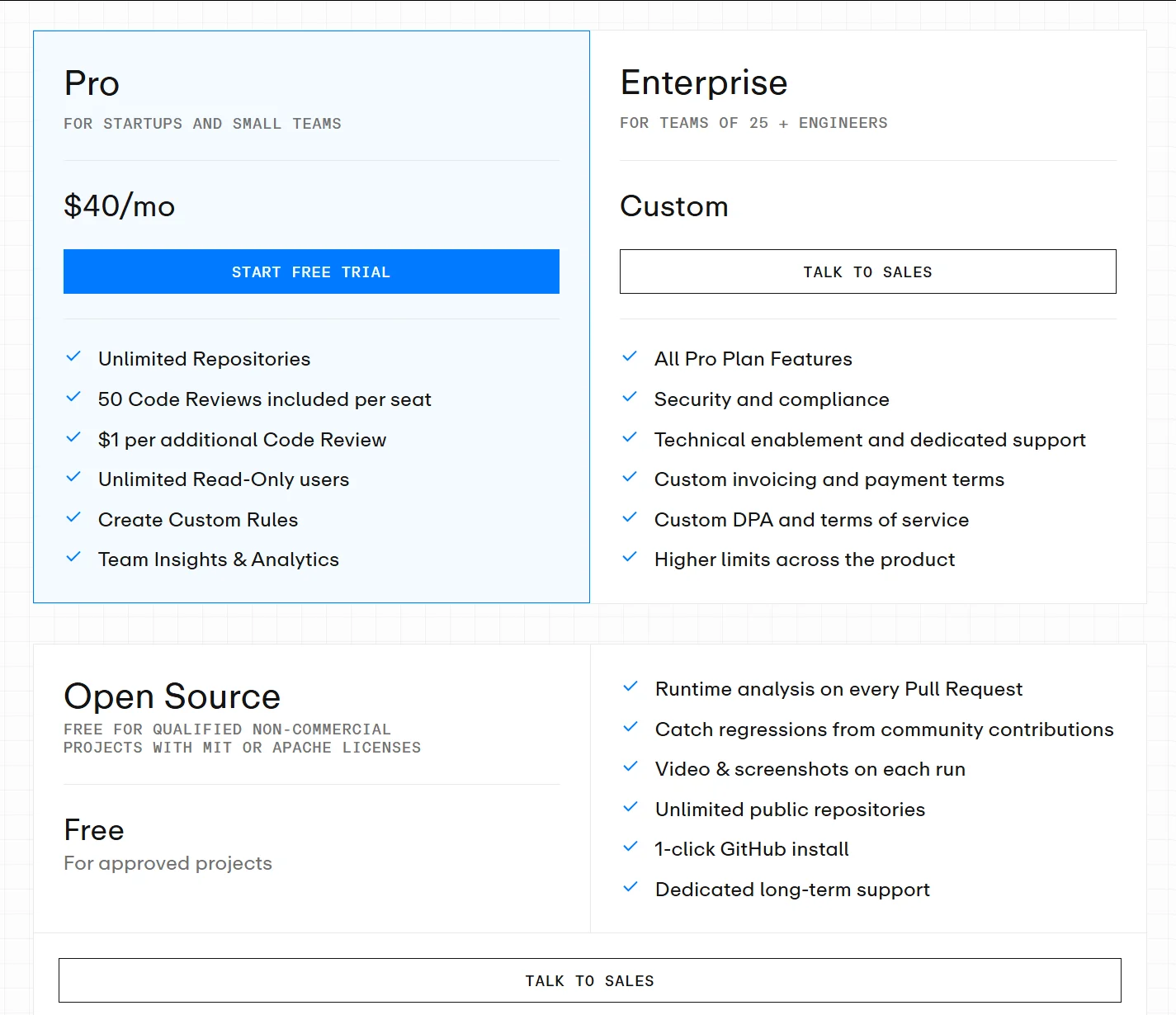
Public materials reference a free trial (first reviews free, no card required in some promotions), a paid plan around $40/month after the trial, and free forever for open-source projects. Exact current packaging should be confirmed on the site, as launch and open-source policies can evolve.
Strengths
- Genuine runtime execution on every PR rather than static analysis alone.
- Targeted, change-aware test planning that does not require a pre-existing brittle suite.
- Rich evidence (video, logs, reproduction steps, code pointers) delivered directly in the PR.
- Automatic re-run on fix to confirm resolution.
- Low-configuration onboarding for many web applications.
- Clear differentiation in a crowded AI code-review market.
- Security posture (isolation, SOC 2) that supports enterprise adoption.
- Practical relief for teams drowning in AI-generated PR volume.
Limitations and Considerations
Ito is strongest on web applications that can be built and exercised in a containerized environment. Highly specialized, hardware-dependent, or extremely complex multi-service architectures may require additional configuration or may not be fully covered out of the box. Agent exploration is powerful but not omniscient; critical business flows still benefit from explicit plain-English instructions and human prioritization. Runtime execution takes longer than pure static analysis, so teams should set expectations around turnaround time per PR. As with any automated system, false positives or incomplete coverage of obscure edge cases can occur; the evidence package is intended to make triage fast. Coverage of pure backend or non-browser surfaces continues to expand but remains secondary to full-stack user-flow validation.
Who Should Use Ito
Ito is ideal for engineering teams that:
- Ship frequently and are already using (or considering) AI coding agents that increase PR volume.
- Spend significant time on manual verification of AI-generated or complex changes.
- Want runtime confidence before merge without maintaining a large, brittle E2E suite.
- Value video and log evidence inside the PR for faster triage and knowledge sharing.
- Need a security-conscious, isolated execution model.
It is less critical for purely backend services with no user-facing flows, for teams whose existing test suites already provide comprehensive pre-merge confidence, or for organizations that prefer fully manual review for every change.
The Product Hunt Verdict
Ito introduces a meaningful category distinction: execution-based, behavioral code review. In a landscape full of tools that read diffs and post comments, running the actual application and returning video, logs, and reproduction steps is a higher bar for confidence. For teams whose bottleneck has shifted from writing code to verifying that the code works, Ito offers a practical way to automate the most repetitive and error-prone part of that verification.
The practical evaluation is straightforward. Connect a repository, open a realistic pull request that touches important user flows, and inspect the evidence Ito posts. If the runtime findings catch issues that static reviewers and existing suites miss, and if the evidence package accelerates rather than slows the review cycle, Ito is delivering on its central promise.
Agents are writing more of the code. Someone — or something — still has to run it. Ito is built so that “someone” can be an automated, evidence-producing system that sits on every pull request.